Many thanks to the commentators “the all knowing” here is a super course about the physics of sound.
This is a video every aspiring piano tuner should listen carefully. This video last more than an hour but is mandatory for any aspiring piano tuner.
Every musician should also look at this video very seriously.
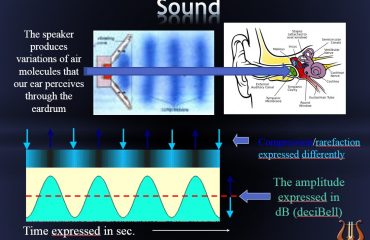
Have you ever wondered about the annoying hum your car makes at a certain speed on a particular stretch of highway? Or why a flute’s notes are higher than a trombone’s? Walter Lewin uses rubber hose, wooden boxes with holes, metal plates and an assortment of other home-made instruments to demonstrate how objects produce sound. It all boils down to how something vibrates — pushing air out in all directions.
Lewin illustrates the shape of sounds, taking a rope tethered at one end, shaking it up and down at different speeds and producing specific wave shapes. These shapes are the rope’s resonant frequencies, or harmonics. It’s the same for a bowed violin, where the oscillations of the strings generate a set of harmonics, producing the notes we hear — the faster the oscillations, the higher the tones. Lewin invites children from the audience to produce sounds with their musical instruments, and shows the amplitude and frequency of the tones. Later he demonstrates destructive resonances: video of a bridge that twists so violently that it collapses, and then, live in the laboratory, the shattering of a wine glass with progressively louder and higher tones. In this event where physics meets performance art, Lewin provides surprises throughout.
Tagged with: piano tuning
Filed under: Uncategorized
Like this post? Subscribe to my RSS feed and get loads more!


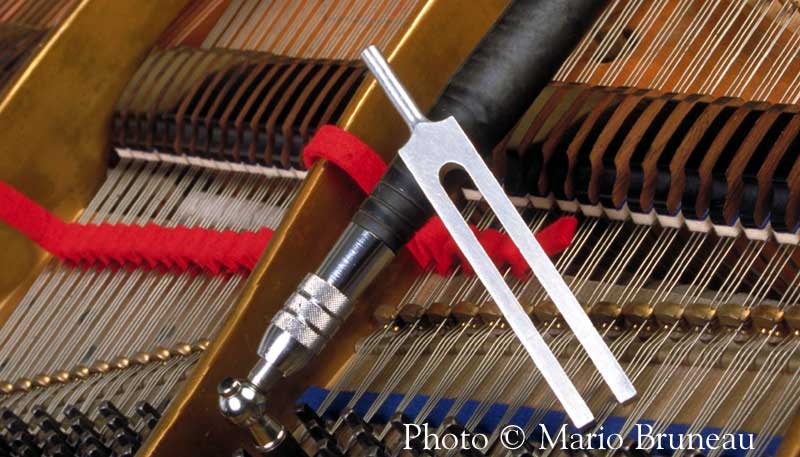
You tune the string so it matches exactly with the tuning fork (turn it so you stop hearing beats).
Piano tuning is quite complicated if you don’t know what you are doing and often requires a tool of some sort. As for listening for sound waves and vibrations, thats just something you acquire with time and practice. Years of musicianship sometimes still cannot achieve the needed precicion.
Beats work on the principle of interference. When two waves coincide with each other they are effectively added together. When two waves are just slightly different, that can create beats.
Here’s a simple way to look at it. Let’s say you have two piano strings which are perfectly tuned to one another. You pluck both of them. The sound waves produced by each will be exactly the same. The high and low points of wave #1 will exactly coincide with the high and low points of wave #2. To your ear that will sound like a single note only twice as loud.
Now let’s slightly change string #2 and re-pluck both strings.
Now the high and low points of string #1 are close but not exactly aligned with the high and low points of string #2. Over time a high point of string #1 is going to coincide with a low point of string #2, cancelling each other out. To your ear that would be a moment of silence. At other points in time the different parts of each sound wave will match up with each other producing varying differences of volume.
That’s what a beat is. The periodic quieting of the note.
That explanation was a little convoluted. It would be easier to explain with a chalkboard. I hope it helped, though.
you might consider looking into:
http://mitworld.mit.edu/video/168/
as he describes the basics